Overview
Long before Portland cement was invented in the 19th century, India's forts, temples, and Chettinad mansions stood for centuries bound and plastered with slaked lime (Chunam / Sunnambu). Sri Auro Bindo Traditional prepares authentic slaked shell and rock lime mortars ground with river sand, crushed brick (Surkhi), marble dust, and fermented herbal admixtures (Kadukkai, palm jaggery, and aloe vera) for breathable interior/exterior walls and heritage conservation.
Designs, patterns & colours
Chettinad Burnished Ivory Lime (Vellai Poosi / Araish)
Mirror-smooth, water-shedding lime and marble-dust finish burnished with agate stone and traditional egg-white/plant mucilage.
Matte Breathable Heritage Lime Float Finish
Soft, luminous mineral wall texture for bedrooms, courtyards, and heritage facades.
Surkhi-Lime Pozzolanic Exterior Plaster
Warm terracotta-pink hydraulic mortar blended with powdered burnt clay brick for monsoon-exposed facades.
Raw materials & preparation
- Aged Slaked Quicklime Putty (Calcium Hydroxide aged under water for minimum 3 to 6 months) or Natural Hydraulic Lime (NHL).
- Washed Sharp River Sand, Crushed Dolomite/Marble Powder & Burnt Brick Surkhi.
- Traditional Organic Modifiers: Fermented Kadukkai (gallnut) + Jaggery water, Bel fruit (Bael) pulp, Fenugreek (Vendhayam), and Aloe Vera gel.
Step-by-step procedure
Step 1: Lime Slaking, Wet Grinding & Herbal Fermentation
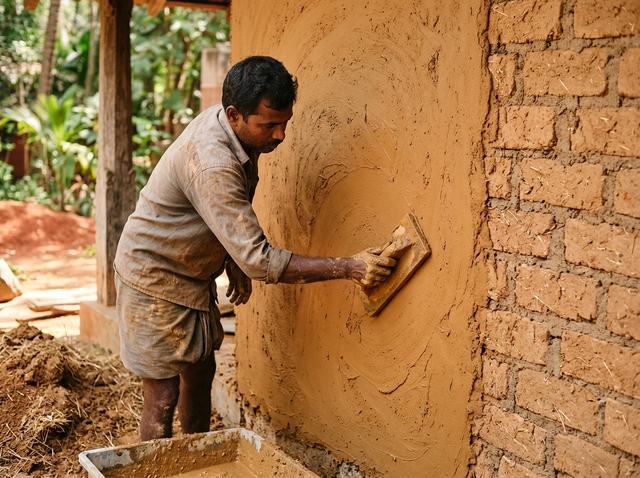
Step 2: Substrate Wetting & Spatterdash Key Coat
Step 3: Base & Scratch Coats (12–15 mm)
Step 4: Fine Finish / Burnished Punam Coat (3–5 mm)
Key advantages
- Self-Healing & Flexible: Autogenous healing seals hairline cracks as rainwater dissolves and re-deposits calcium carbonate.
- Naturally Alkaline & Anti-Fungal: High pH (~12) naturally inhibits black mould and algae in humid coastal climates.
- Carbon Sink & Breathable: Re-absorbs CO2 during curing and allows walls to release trapped dampness.
Honest limitations
- Slow Carbonation Cycle: Takes 2 to 4 weeks per coat to cure fully compared to 7 days for cement.
- Caustic During Mixing: Requires protective gloves and goggles for artisans during slaking and application.
Health, air quality & environment
Established building science: Scientifically proven high alkalinity prevents indoor Aspergillus and Penicillium mould growth without toxic biocides, while high vapor permeability prevents hidden interstitial wall rot.
Traditional perspective: Traditionally celebrated in South India for its luminous pearl-like coolness and hygienic purity.
Installation, maintenance & restoration
Installation & finishing: Unlike cement which sets rapidly by hydration, lime sets slowly by carbonation—absorbing carbon dioxide (CO2) from the air to turn back into natural limestone (CaCO3). Gentle misting and protection from scorching sun during the first 10 days are essential.
Routine care: Clean with plain water and a soft brush. Refresh every 3–5 years with a single breathable coat of slaked lime wash.
Restoration: Essential for heritage buildings: replacing incompatible cement patches (which trap salt and spall antique brick) with vapor-permeable sacrificial and structural lime plasters.
Photo gallery
Tap a photo to enlarge.